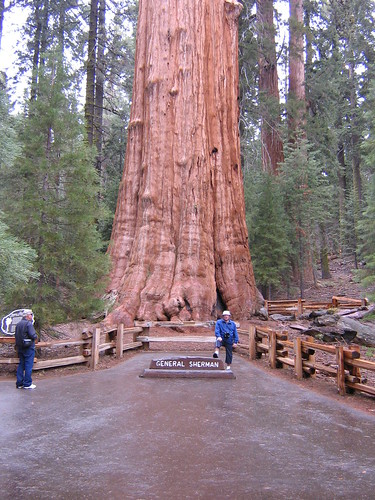
The General Sherman tree is estimated to weigh about 2100 tons, the weight of 1489 cubic meters (52,584 cubic feet) of wood in its trunk, excluding branches and roots. Its height is 84.2 m (274.9 ft) and the girth at ground level is 33 m (109 ft).
As of 2009, the largest Giant Sequoias (all located within California) by volume are about 50, according to Wikipedia and other sources. Following General Sherman tree, General Grant tree (Grant Grove), President tree, (Giant Forest), Lincoln tree (Giant Forest), Stagg tree (Alder Creek Grove), Boole tree (Converse Basin), Franklin tree (Giant Forest), King Arthur tree (Garfield Grove), Monroe tree (Giant Forest), and Genesis tree (Mountain Home Grove) come in the list of largest ten trees in the world.
When we use superlatives like the largest tree, please note that these are based on the volume of wood in the main trunk (stem) of the tree. These measurements need not be accurate, and in fact, have a low degree of accuracy, varying up to 14 cubic meters (+/-), due to difficulties in taking accurate measurements.
To calculate the volume, the diameter of the stem is measured at set heights up the trunk and it is assumed that the trunk is circular in cross section. It is also assumed that the taper between measurement points is even. Also, if the tree has cavities it is not taken into account as it is neither easy to measure the cavity nor easy to know the extent to which the cavity exists. Also, the volume measurements show only the volume of the trunk, and do not include the volume of wood in the branches or roots.
The Hazelwood Tree, not listed in the 50 largest trees, had a volume of 36,228 cubic feet before losing half its trunk in a lightning storm in 2002. If it were still at full size it would have been the 16th largest giant sequoia on earth. Click here for more details and photo of General Sherman tree.
Showing posts with label General Sherman. Show all posts
Tuesday, March 2, 2010
Giant Forest trees in Sequoia National Park
Sequoia National Park, in the southern Sierra Nevada, east of Visalia, California, USA, was established in 1890. The park covers an area of 1,635 squire km, and has the highest peak, Mount Whitney (14,505 feet or 4,421 m above sea level), in the contiguous 48 states of USA.
Sequoia National Park is located south of Kings Canyon National Park, contiguous with it and the two national parks are administered by the National Park Service.
Sequoia National Park is world famous for its Giant Sequoia trees (Sequoiadendron giganteum), including the General Sherman tree, one of the largest trees in the world. The General Sherman tree grows in the Giant Forest within the park, and five of the ten largest trees in the world by volume on the planet are located within the Giant Forest, which is connected by Generals Highway to Kings Canyon National Park.
Sequoia National Park is located south of Kings Canyon National Park, contiguous with it and the two national parks are administered by the National Park Service.
Sequoia National Park is world famous for its Giant Sequoia trees (Sequoiadendron giganteum), including the General Sherman tree, one of the largest trees in the world. The General Sherman tree grows in the Giant Forest within the park, and five of the ten largest trees in the world by volume on the planet are located within the Giant Forest, which is connected by Generals Highway to Kings Canyon National Park.
Labels:
General Sherman,
giant sequoia,
sequoia,
Sequoia National Park
Monday, March 1, 2010
Base of General Sherman tree
Labels:
General Sherman,
giant sequoia
Sequoia Redwood California
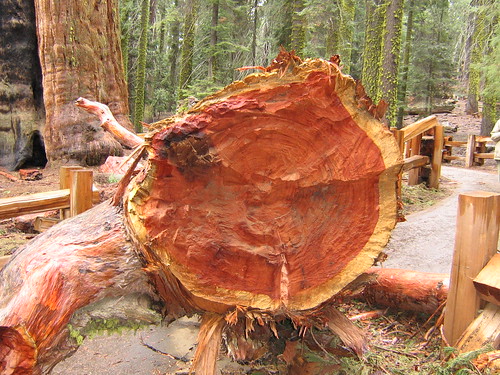
Broken branch of the General Sherman tree: In January 2006, this largest branch on the tree broke off from the main trunk and fell to the ground smashing part of the enclosing fence and cratered the pavement of the walkway surrounding the giant sequoia.
Labels:
General Sherman,
giant sequoia
General Sherman, the world's largest tree
General Sherman tree, the Giant Sequoia tree with a height of 275 feet (83.8 meters), is the world's largest individual organism by volume, since its wood volume was calculated in 1931. It means this sequoia tree is the largest tree in the world. This Giant Sequoia has a volume of 1,487 cubic meters (52,500 cubic feet), as measured in 2002. Its trunk alone is estimated to weigh over 1,800 tons. It is located in the Sequoia National Park, California, United States. The tree is believed to be between 2,300 and 2,700 years old.
However, the largest single-stem tree ever measured is the now dead Lindsey creek tree, a Coast Redwood tree with a minimum trunk volume of over 2,500 cubic meters (88,000 cubic feet) and a weight of over 3,300 tons. It fell over during a storm in 1905.
In 1879 General Sherman tree was named after William Tecumseh Sherman, the American Civil War General, by the naturalist James Wolverton, who had served as a lieutenant in the 9th Indiana Cavalry under Sherman.
In January 2006 the largest branch of the General Sherman tree, protruding from about 1/4th down the trunk, broke off. The broken branch had a diameter of over 2 meter (6 feet) and a length of over 30 meter (100 feet). However, the loss of the branch did not alter the tree's status as the largest tree, because its size has been calculated using measurements of trunk volume excluding branches.
However, the largest single-stem tree ever measured is the now dead Lindsey creek tree, a Coast Redwood tree with a minimum trunk volume of over 2,500 cubic meters (88,000 cubic feet) and a weight of over 3,300 tons. It fell over during a storm in 1905.
In 1879 General Sherman tree was named after William Tecumseh Sherman, the American Civil War General, by the naturalist James Wolverton, who had served as a lieutenant in the 9th Indiana Cavalry under Sherman.
In January 2006 the largest branch of the General Sherman tree, protruding from about 1/4th down the trunk, broke off. The broken branch had a diameter of over 2 meter (6 feet) and a length of over 30 meter (100 feet). However, the loss of the branch did not alter the tree's status as the largest tree, because its size has been calculated using measurements of trunk volume excluding branches.
Subscribe to:
Posts (Atom)