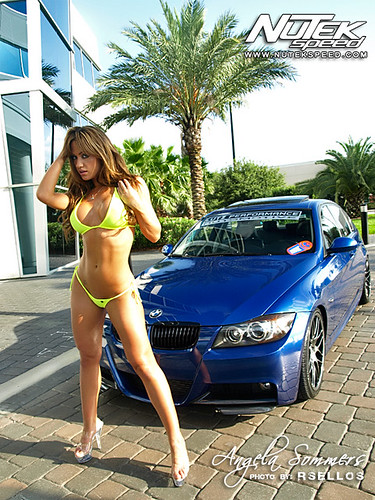


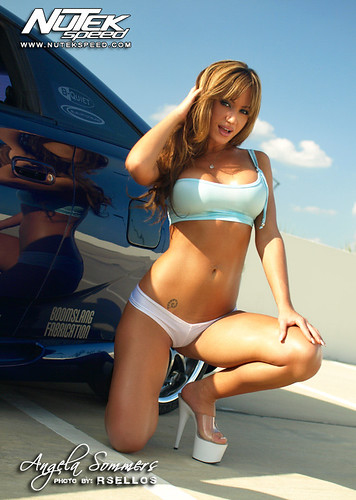
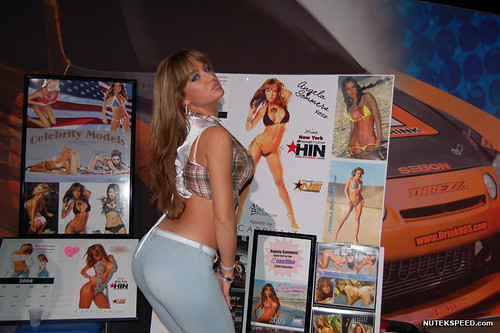
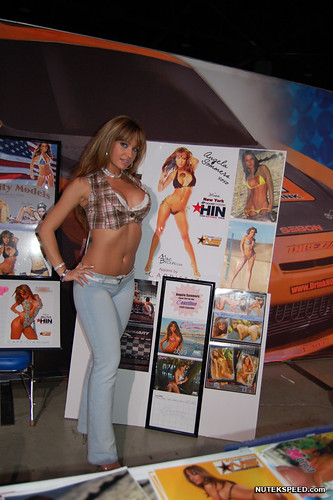
Model Angela Sommers photoshoot for Automotive Magazine

Model Angela Sommers photoshoot for Automotive Magazine



When technologically advanced automobiles designing gave way to the old manufacturing technology, encasing wheels in fenders and extending hood to the full width of the car, the former practices became rather impossible. Further there was tremendous advertising and public interest in the new models of automobiles in the 1950s. For this reason, custom cars began to be developed, swapping headlamp rings, side strips, tail lights, grilles, bumpers, as well as frenching and tunneling the head and taillights.
Re-fitters or re-builders of custom cars even cut through the sheet metal, removing bits to make the car lower, welding it back, and adding a lot of lead to make the resulting form smooth. Chopping made the roof lower and sectioning made the car body thinner from top to bottom. A process known as channeling cut notches in the floorpan where the body touches the frame to lower the whole vehicle body. In the custom car culture, those who just changed the appearance were looked down upon. So, people went for total car customization.
Essentially, chopping and channeling are customization procedures in the ‘Kustom Kulture’ and among hot rodders, both procedures are sometimes applied together. Sectioning is used to remove horizontal sections from the car body. It also has the advantage of reducing a car's frontal area and reducing wind resistance. This sort of bodywork is popular on race cars, kustoms, minitrucks and leadsleds.




Customized cars are very popular with the well-heeled and the younger generation automobile users. Customization can be for many purposes, either to modify a latest model vehicle to meet personal choices and styles, or to modify and use vintage cars or classic automobiles. It is not limited to cars but, anything that runs on the road mechanically, including bikes, trucks, pickups, trailers, etc. can be customized.
A passenger vehicle can be modified in many ways. A custom car may be altered to improve its performance by altering or replacing the engine and transmission. Or, a car may be a personalized as a personal style statement by the re-styler or re-builder of custom cars. They make the car look unique, dissimilar to factory finished cars. Customs are distinct from hot rods, the typically American cars with large engines modified for linear speed.
To begin with, the development of hot-rodding, the change in the design of the cars being modified, was for pre-World War II cars, with running boards and simple fenders over the wheels – running boards allowing people to stand on it even while riding. Then they were further modified by removing running boards, either removing the fenders entirely or replacing them with very light cycle fenders.The objective was to put the most powerful engine in the lightest possible frame and body combination. The suspension was usually altered to make the car lower. The front was often made much lower than the rear. Gradually some hot rods and custom cars swapped the old solid rear axle for an independent rear axle, often from Jaguar. Only rarely was the grille of one make of car replaced by another. The original hot rods were plainly painted like the Model A Fords from which they had been built up, and only slowly begun to take on colors, and eventually fancy orange-yellow flamed hoods or candy-like deep acrylic finishes in the various colors.
However, for those who like custom cars, there is no limitation of anything, only your imagination, fashion and style requirements to suit your glamour quotient, the depth of your pocket and, of course, a skilled, knowledgeable re-builder, make all the difference. If it is a style statement for the well-heeled, it is a big business for re-builders of custom cars.